Progress Clocks
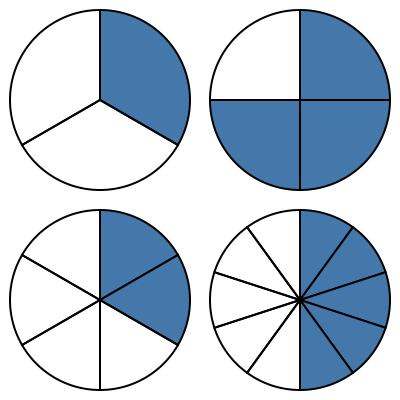
Progress clocks are a tool for tracking and visually representing effort expended toward a task, or a countdown until something bad happens.
At its heart a progress clock is a circle divided into wedges that serves as a visual representation of how close something is to being done and how many steps are left.
In the basic progress clock, wedges are often filled by successes or failures (or two wedges for criticals), but the criteria to fill a wedge could be anything.
An enchanter Hero could have a progress clock tracking the downtime they’ve spent to make their Staff of Smashing Annoying People, or they may be filled each time the alien hive mind consumes a human and gets one step closer to understanding humanity well enough to consume the whole human race.
Major villains are differentiated from normal challenges by having a progress clock, it will take more than one exchange to take them out. These are often called complex challenges.
Clock Sizes
Progress clocks can have two or more sections only
limited by the number that can be told apart.
Things get dicey over twelve, but even then,
there can be linked clocks. When one completes,
simply roll over to the next.
For standard progress clocks that fill one section on a success, and two on a critical success (or failures) consider if a progress clock less than three is desirable. A progress clock of three can’t be overcome in a single action, while a two section clock could be.
Uses
Clocks generally fall into two categories: Effort and countdown. Effort clocks are generally positive and fill while the Heroes succeed at things, while countdown clocks fill when the Heroes fail, their adversaries succeed or simply with the passage of time.
If the Heroes are trying to do something that they can’t immediately succeed at, they get an effort clock to track how close to success they get. This might be something like developing a contact or escaping pursuit.
On the other side are countdown clocks which get filled when progress is made toward a bad outcome. This can happen when Heroes fail stealth rolls and guards get more and more suspicious until they trigger a full alarm, or simply by taking downtime, allowing the villains to progress their plans unimpeded.
Things get interesting when they are paired together. The Hero is trying to hunt down a Totally Bad Person who’s trying to escape the area. The Bad person gets a countdown to escape clock, while the Heroes a capture effort clock. Heroes failing fill the escape clock, while success fill the capture clock, whichever clock is filled first dictates the outcome.
Examples
The Heroes may have decided to dig a tunnel under the prison wall to rescue an ally. This isn’t the sort of thing that can normally be done instantly, and the longer they dig the more likely the guards will be alerted.
Two progress clocks are created, one for the tunnel and one for alarm. Each few hours the Heroes decide to spend tunnelling they will roll their Attribute Roll and each success will progress the tunnel clock, while each failure progresses the alarm clock. If the alarm clock is filled before the tunnel clock, then the guards discover the tunnelling attempt before it’s complete. If the tunnel completes, then the Heroes are able to complete the tunnel before being discovered.
The Heroes and a rival gang are competing for the hearts and minds in a new territory. This is a slow process, taking days.
Each day the rival gang fills a section of their countdown timer, and if it fills the territory falls to the rivals. Each time the Heroes do something to try to sway the people they can make an Attribute Roll and fill their own progress clock, to win the minds of the territory.
And of course the classic, there is a nuclear bomb hidden in the city and the Heroes need to discover it before it goes off killing everyone the Heroes care about.
The GM fills the sections at an appropriate cadence as the Heroes investigate and interrogate until they find the bomb or… They don’t.