Stress & Blood
Consequences are a generalized form of harm. When a Challenge results in a Hero taking one or more Consequences it means they have been harmed in the attempt.
Consequences come in two forms: Stress and Blood. Stress is mental or psychic trauma, while Blood is physical damage. Whether it is Stress or Blood depends on if the Challenge was stressful or bloody.
Mechanically, Stress and Blood both have 3 segment progress clocks, once one of the clocks is filled, any additional consequences of that type cause the Hero to take a Wound or a Trauma depending on which clock was filled. Stress, Blood, Wounds and Trauma are all tracked separately.
Stress or Blood Progress clocks are cleared at the end of the scene, while any actual Wounds or Trauma will remain until recovered.
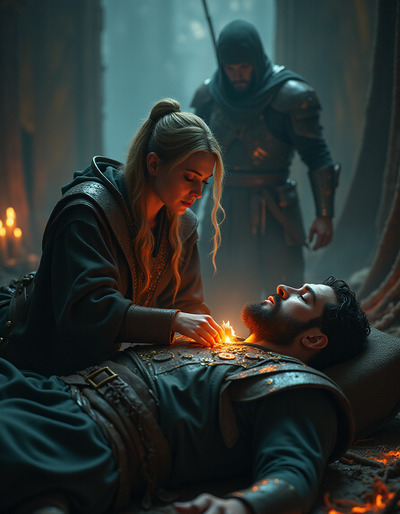
Wounds and Trauma
Each Wound and Trauma add a level of disadvantage to each Attribute Role. Blood and Trauma stack, so a Hero with one Wound and one Trauma would have two levels of disadvantage.
Disadvantage counters advantage on a one-for-one basis. A level of Disadvantage applies to the attribute with the greatest level of advantage first. In the case of multiple Attributes with the same level of advantage, the player chooses which Attribute the Disadvantage applies to.
In the case where there are no advantage dice to counter, the player rolls an additional die, and chooses the lowest number instead of the highest. Each additional level of disadvantage adds another die, still choosing the lowest roll.
Taken Out
A player can choose to have their Hero taken out at any time. If a player makes that choice then at the end of the challenge, they are allowed to make two First Aid rolls, instead of the normal one.
If at any point a Hero attempts to make an Attribute Roll while all attributes are at Disadvantage, they are taken out.
A Hero that is taken out is not dead unless that is the outcome the player chooses.
They are in trouble and likely need the help of their comrades to get out of their current predicament.
The narrative effect of being taken out will depend on the situation and whether the challenge was eventually overcome by the Hero’s comrades or if the Hero is at the mercy of whatever took them out.
First Aid
At the end of any scene in which a Hero took Wounds or Traumas the Hero may make a recovery roll to immediately treat the Wounds or Trauma.
A separate roll is made for Wounds and Trauma.
The disadvantage levels applied by the Wounds and Trauma apply
to this roll, but this roll is considered safe.
Type |
Recovery Difficulty |
|---|---|
Stress |
16 |
Wounds |
20 |
The Trauma recovery roll has a difficulty of 16 and is an Attribute Roll. Any appropriate Boons can be added to this roll as per normal.
The Wound recovery roll has a difficulty of 20 and is also an Attribute Roll made with any appropriate Boons. The Strategy to recover from Trauma and Wounds will almost always be different.
Each Effect Level removes one Trauma or Wound as appropriate to the roll being made. A post incident recovery roll can’t recover more Trauma or Wounds than the Hero took in the incident they are recovering from.
Rest, Relaxation and Medical Care
If during the narrative there comes a moment where the Hero does something to get an opportunity to recover they will be able to make another recovery roll.
Event |
Recovery Type |
|---|---|
Sleep |
Both |
Visit medical professional |
Wounds |
Visit a mental health professional |
Trauma |
Spend time socializing in a safe space |
Trauma |
Engage in emotional self-care |
Trauma |
Engage with an unhealthy coping vice |
Trauma |
Something character specific |
Trauma |
This roll works the same as First Aid except it can remove Wounds or Trauma that weren’t recently acquired.
Different Heroes have different methods of dealing with Trauma, so if it seems the Hero is engaging with their personalized method of handling trauma, they should be able to make a Trauma recovery roll.
Wounds generally require rest, magic or at least a medical amateur.