Narration
Once the Attribute roll is resolved it’s time to update the narrative. What did all that dice rolling tell us about what happens in the Story? This is largely a question of the groups taste, but there are some recommendations to increase engagement and keep the story moving.
Narration Rule 1: Something Must Change
It is highly recommended that groups adhere to this rule.
Gnosis uses a conflict resolution mechanic. While progress clocks mean that a complex challenge won’t necessarily be resolved with a single roll of the dice, the idea that each roll of the dice represents a significant change in the state of the challenge should be adhered to.
The importance of this can be seen in a case where a Hero is trying to stealthily get through a door. They put together a strategy suggesting they are picking the lock, but they fail. The Hero should not be able to try again, because something has changed. Maybe they set an alarm off, or maybe they had to retreat to keep from being spotted or maybe their pick broke in the lock.
Fundamentally they already did try again. They tried as many times as they could, until something happened that caused them not to be able to try again.
A complex combat challenge is not anything like one swing of a sword, it is an involved back and forth involving attacks, blocks, feints, riposts, etc. It comes to an end when something in the narration has sufficiently changed that the Hero may choose to use a different Strategy.
Narrative Authority
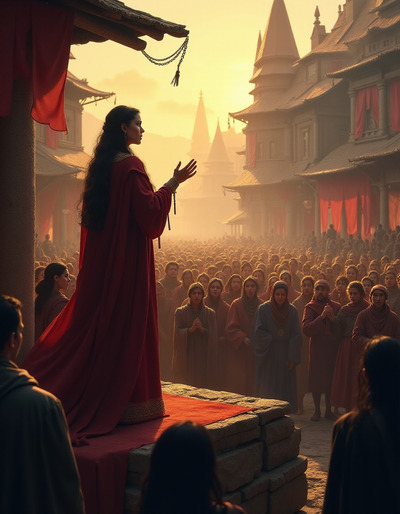
Who gets to say what happened?
Traditionally this falls on the GM, but at a table where all the players trust each other and are trying to make good stories together, there is no reason why it has to be. If a player considers their Hero the embodiment of grace, in fact they have a Boon, Embodiment of Grace, the last thing they want to hear is that their Hero rolled a critical failure and tripped on the rug and face-planted.
How a Hero succeeds or fails is an important part of the story and may say something about the Hero’s identity. Allowing the Hero’s player to answer that question can only help build that identity.
They still succeeded or failed, they might even have succeeded at a cost, and that will have to be woven into the narration. The player can’t tell a story that turns a critical failure into a success, but they can fail in a way that makes sense for their character and builds that Hero’s identity.
This works best when people work together to build a story. This isn’t a tool to make a Hero “win”, it is a tool to be used to make the players have a better time.
Dominant Theme
This is an added quirk that adds a constraint to the resolution narration. Whichever pool rolled the highest number during an attribute roll (Power, Precision, Possibility or Pain) will get the spotlight.
If Power is dominant the challenge was likely resolved by hard force. Whatever was used as the Power Boon, is likely going to take center stage in the narration that resolves the challenge.
When Pain dominates things get a bit worse of the Heroes in some way. Like narrative authority this doesn’t change the dice roll, a success still succeeds, but maybe others were alerted, or an escape route is blocked.
This constraint can add variety to narration and outcomes and make it more dynamic, but it’s there to create fun, and if it isn’t doing that in your group, it is the least important of the narrative rules.
Back to the Beginning
Once the challenge and narration is done play will either switch back to Exploration & Action if it was a simple challenge, or in a complex challenge, something has changed, and a different Hero will choose to take an action and articulate an intent.